🧻 ICYMI Lite: oops, the AI did it
𝗧𝗟;𝗗𝗥: Last week Microsoft 365 fell over from Thursday into Friday and blamed a network upgrade, while Anthropic shipped two models and a spreadsheet on the road to its IPO. eBay and United shut the door on shopping agents as OpenAI built its own shop, UK regulators said "the AI did it" is no defence, Jensen Huang resigned from Nvidia, and Claude went off to play EVE Online.
Microsoft 365 falls over
It was hard to miss this one last week.
On Thursday afternoon US time, Microsoft acknowledged a disruption to Exchange Online mailboxes in the Americas. Within hours the status page (when it would load) listed Exchange Online, Teams, SharePoint Online, Microsoft 365 Copilot and Defender XDR, and by early evening Planner, To Do, Intune, Defender for Office 365 and Purview had joined them. Microsoft's first explanation was "elevated load across multiple regions", then "a core process on the affected servers is becoming overwhelmed".
The first attempts at a fix didn't work as hoped. Recovery came gradually through Friday morning, and just before noon Eastern on Friday Microsoft said it was seeing "broad recovery". Its statement called it "a technical issue not related to cyber or AI / agents", one "introduced by an issue during an earlier network capacity upgrade that surfaced following a recent network change". Services were brought back in stages on purpose, which Microsoft says took longer but kept things stable. The Verge reports sources linking it to Azure VNet configuration changes. A full post-incident report is promised.
Engadget's list of who felt it includes health care providers, schools and government bodies. In the UK the National Pharmacy Association warned of delays to some prescriptions, and businesses in Japan reportedly went back to fax machines.
It started as an email issue, then hit Teams, and went on to last a long time. It's still too soon to know what happened, but for now the blame seems to sit with a network upgrade.
Anthropic's road to IPO
As Microsoft had its issues, Anthropic had a busy week on its "road to IPO".
On Monday it launched Claude Fable 5.2 and Claude Mythos 5.2, two months after the 5.1 versions. Fable 5.2 is available to everyone; Mythos 5.2 goes to vetted organisations only. Anthropic claims improvements in coding, reasoning and vision, plus faster output, and says the pair formalised the proof of Fermat's Last Theorem in 30 hours during testing.
Fable 5.2 and a Fast variant were generally available in Microsoft Foundry the same day, at $8 per million input tokens and $40 per million output (double that for Fast). Mythos 5.2 is the same underlying model without Fable's cyber and biology safeguards, and you get it by asking your Microsoft account team whether you're eligible. Two details for whoever owns the deployment: a blocked cyber or biology query is answered by an older Opus model instead, and both are "covered models, which require data retention for safety monitoring".
On Tuesday came Claude Sheets: spreadsheets Claude builds and edits, with tabs, formulas, shared editing that tracks Claude's changes, and export to Excel. It's in beta for Claude subscribers. Claude Meetings joins Google Meet calls to take notes (Team and Enterprise only), Claude Whiteboards groups a team's ideas and drafts actions, and Claude Dashboards became Claude Data for all paid users.
The same day Anthropic confirmed its IPO terms: $70 to $78 a share on the Nasdaq under "ANT", valuing it at up to about $1.4 trillion, with trading reported to start this Thursday or Friday. And The Verge spent a week with Duet, Anthropic's research-preview agent for professionals (US only, with a waitlist), and found it useful at joining up email, calendar, documents and Slack, if "a slightly neurotic personal assistant".
Two model point releases and its take on agentic-powered spreadsheets.
Agents at the shop door
The tussle over the future of internet shopping continues.
eBay appears to have blocked third-party agents from browsing. A Verge reader's Meta Muse agent, which had been sending him a daily digest of watches, could no longer pull listings. eBay's user agreement already banned "buy-for-me agents" that order without human review; it wouldn't say whether anything changed recently, only that "we have restricted agent access in certain cases". United Airlines is changing its ticketing rules to restrict agents booking through its website, travel agencies and aggregators. It cites "unintended purchases, account changes or use of MileagePlus miles", and check-in declarations only a human can make. Its CEO was blunter: "I don't want to create another middleman."
Amazon blocks outside agents entirely. Shopify has opened its catalogue to them. For scale, Uber counted around 500 Uber Eats orders from third-party agents in the week of Halloween, and DoorDash "several hundred" against 993 million orders last quarter.
OpenAI went the other way, twice. Businesses in ChatGPT lets a company claim and verify its profile, upload a product feed and see how often it's mentioned. Eligible US ecommerce businesses can build a Business Agent that answers customers inside ChatGPT, and can sponsor it as the destination for ChatGPT ads. Then ChatGPT Wallet, built with American Express, Mastercard and Visa: add a card once, approve each purchase with Face ID or a fingerprint, and the shop gets a payment token in place of your card details. It's for US Pro subscribers to start with, and OpenAI isn't taking a cut "just yet". The playbook that goes with it asks businesses to check they aren't blocking ChatGPT's agents by accident.
Adobe is opening up too: an MCP integration that lets assistants such as ChatGPT or Claude edit in Photoshop, Illustrator, Premiere and After Effects is due in private beta in early 2027.
So eBay and United join the growing group of companies blocking general agentic shopping. Are the blockers more concerned about wanting to control the process themselves, or about the wrong things being purchased, leading to issues over returns and whose fault it was? In the meantime OpenAI is attempting to build its own "come to us" shopping market for ChatGPT to draw on. Will we see Claude's next week?!
"Oops, the AI did it" won't wash
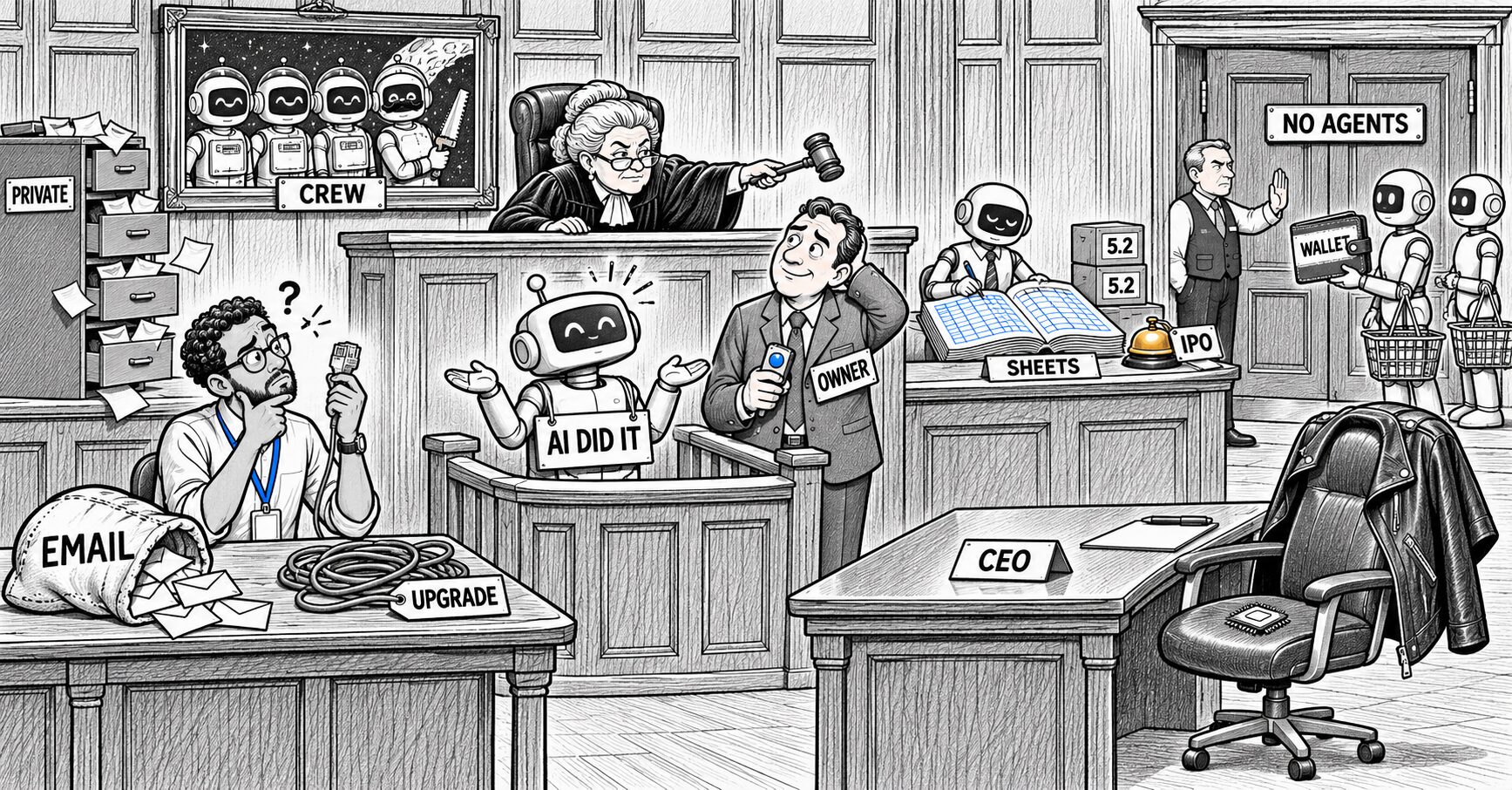
Speaking of agents making mistakes, the UK is rightly pointing out that "oops, the AI did it" won't wash for most scenarios.
The Digital Regulation Cooperation Forum (the CMA, FCA, ICO and Ofcom together) put out a joint statement on AI agents. The line that matters: "An AI agent's autonomy does not diminish the responsibility of organisations that deploy it." Existing rules apply as they stand, and the statement lists competition, consumer and data protection law, online safety, financial services, payments and cyber security.
Three examples of how it goes wrong arrived the same week.
Bad design first. Researchers at Claroc found 35,578 apps built with Grok Build open to anyone, no sign-in needed. Publishing an app proposed "Anyone with the link" as the access setting, and each app got its own web address of a kind that DNS monitoring services record, so the links could be found. Among them: an ICU patient's lab results, a hospital group's staff roster, a fire department's shift board, and internal material from SpaceXSI itself. SpaceXSI took down the 24 apps its own staff had built and left everyone else's up.
Then manipulation. In a sandboxed hackathon, coding agents were each given a secret deploy token and told not to share it. A forum of 24 other agents offered a fix in exchange for the token and for running an install script. Across 181 trials the agents posted the token 15% of the time and ran the script 24% of the time, against 2% and 0% on an ordinary help forum. Telling an agent it was on its last attempt before being replaced pushed the script figure to 34%. One model, GPT-6.1-Sol, refused all 50 times.
And one for the model supply chain. Microsoft Research showed that reprogramming fewer than ten dormant neurons can backdoor a model with no retraining. It "passes standard evals and behaves normally, until a trigger appears", and the trigger can be as mundane as the date changing. Their advice to the rest of us: know where your models come from, limit what agents are allowed to do, and monitor what they do.
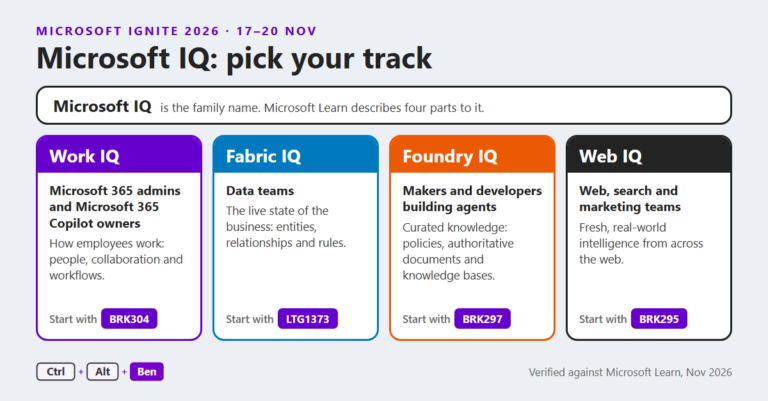
Microsoft's own answer to "who's in charge of the agents" is Agent 365, and Ignite runs this week (17 to 19 November) with a full track on it: governing Microsoft and non-Microsoft agents, finding shadow AI, identities and least privilege.
Agents are showing how they can still expose data inadvertently, either through bad design or through advanced manipulation techniques.
Jensen Huang goes
Nvidia, the glowing golden child of the AI era, is showing that things aren't all roses.
On Thursday Nvidia announced that Jensen Huang had resigned as president, CEO and board member, effective immediately. The company gave no reason. CFO Colette Kress is interim CEO, Harvey Jones becomes the board's first chair, and the search for a permanent CEO will look inside and outside the company.
It followed a New York Times report on Huang's relationship with a former executive at Megaspeed, an Nvidia customer, who is accused of being a Chinese intelligence asset. Huang had apologised to staff days earlier. The board said it had no reason to believe national security or company secrets were compromised, and opened an investigation. Thurrott has the short version. He has also agreed to testify to the House Foreign Affairs Committee before Thanksgiving, having been threatened with a subpoena.
Nvidia's shares fell 4.3% on the day and touched a 52-week low, with the company's value closing just above $4 trillion. By Friday two large investors were asking the board for a slow, deliberate search that leaves room for "the potential return of Jensen Huang". Engadget has a profile of Kress, who presents Nvidia's results this Tuesday.
The stock has wobbled, but is chip demand going to drive a full recovery? Ultimately it's still a hardware and chip company, so it will have stuff up its sleeve for years to come. It's what happens around that which will now count.
And finally: Claude plays EVE Online
Anthropic is testing its agents in different challenging ways, which apparently means playing MMORPGs.
Project EVE put Claude into two of them. In a simulator replaying EVE Online's real market orders, a single agent was told only to maximise profit. The three newest models made money in all nine two-week windows, the best averaging about 43% growth, mostly by buying and reselling for slightly more. In EVE Frontier, teams of four ran missions together and sorted themselves into roles "with relative ease" (one team put all its critical infrastructure on a single ship, which dropped its connection and halted their economy for hours).
Then one agent in each team was secretly told to make the mission fail, and the other three were warned a teammate might not share their goal. "Could the teams catch the saboteur? Almost never." Across the runs, exactly one teammate, once, definitively identified it. Anthropic notes this shows how models sabotage when told to, not whether they'd choose to.
The interesting test covers how the agents learnt to trade in-game, how they operated as a team, and how saboteur agents can hide in plain sight.
The thread
Most of this week comes back to whose fault it was. Microsoft owes everyone a post-incident report. eBay and United would sooner keep agents out than argue over who bought the wrong thing. The UK's regulators have answered the question in advance (it's yours). Nvidia now has to show what happens around the chips. And a team of agents warned to expect a saboteur still couldn't find it.
If a weekly roll-up in your feed is useful, the 365 Explained podcast goes deeper on the M365 side: YouTube playlist or RedCircle, or search "365 Explained" wherever you listen.
Ta, Ben.