🧻 ICYMI Lite: Ignite special, one Copilot and a meter
𝗧𝗟;𝗗𝗥: Last week was Microsoft Ignite. Microsoft 365 Copilot became one app with Office inside it and a meter on the more capable parts, agents got their own mailboxes and a seat in Microsoft Teams, and Work IQ turned up in ChatGPT. Microsoft To Do got a retirement date without a keynote slide. Outside San Francisco, Microsoft explained the outage and Anthropic went public.
This edition leans on the Ignite sessions themselves. Codes like KEY01 link to the session page, where the recording plays, and the quotes come from Microsoft's auto-captions.
Copilot becomes one app
Copilot is coming together.
Satya Nadella's line in the opening keynote (KEY01) was that "Copilot is the new operating system for work". In practice the Microsoft 365 Copilot app now has a Home that puts Chat and Cowork in a single composer, and Home, Chat, Cowork and Office in Copilot are all generally available (BRK497). Office in Copilot means Word, Excel and PowerPoint files open and get edited inside the Copilot app, and the files stay in your tenant with their sensitivity labels and policies (BRK206).
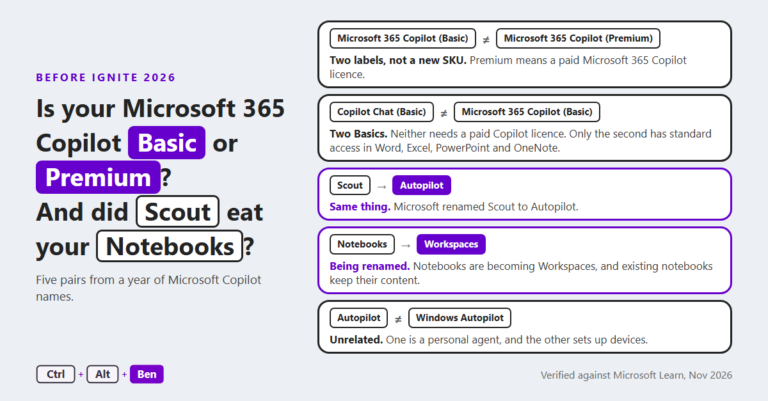
Agents, skills and connectors now sit together as plugins across Chat, Cowork and Autopilot. Admins approve or block them in one registry in the Microsoft 365 admin center, which already lists more than 350 plugins and 235 MCP servers (BRK221). Copilot Notebooks is now Copilot Workspaces (BRK207). Copilot Code, which builds apps, trackers and dashboards from a prompt, is rolling out (three sessions gave three different answers on when it's generally available, so call it December). Paul Thurrott has a good read on what this means for the Office apps.
It's moving from a button in every Microsoft app to one place where work happens. The catch is that the more capable parts are charged by usage.
And it has a meter
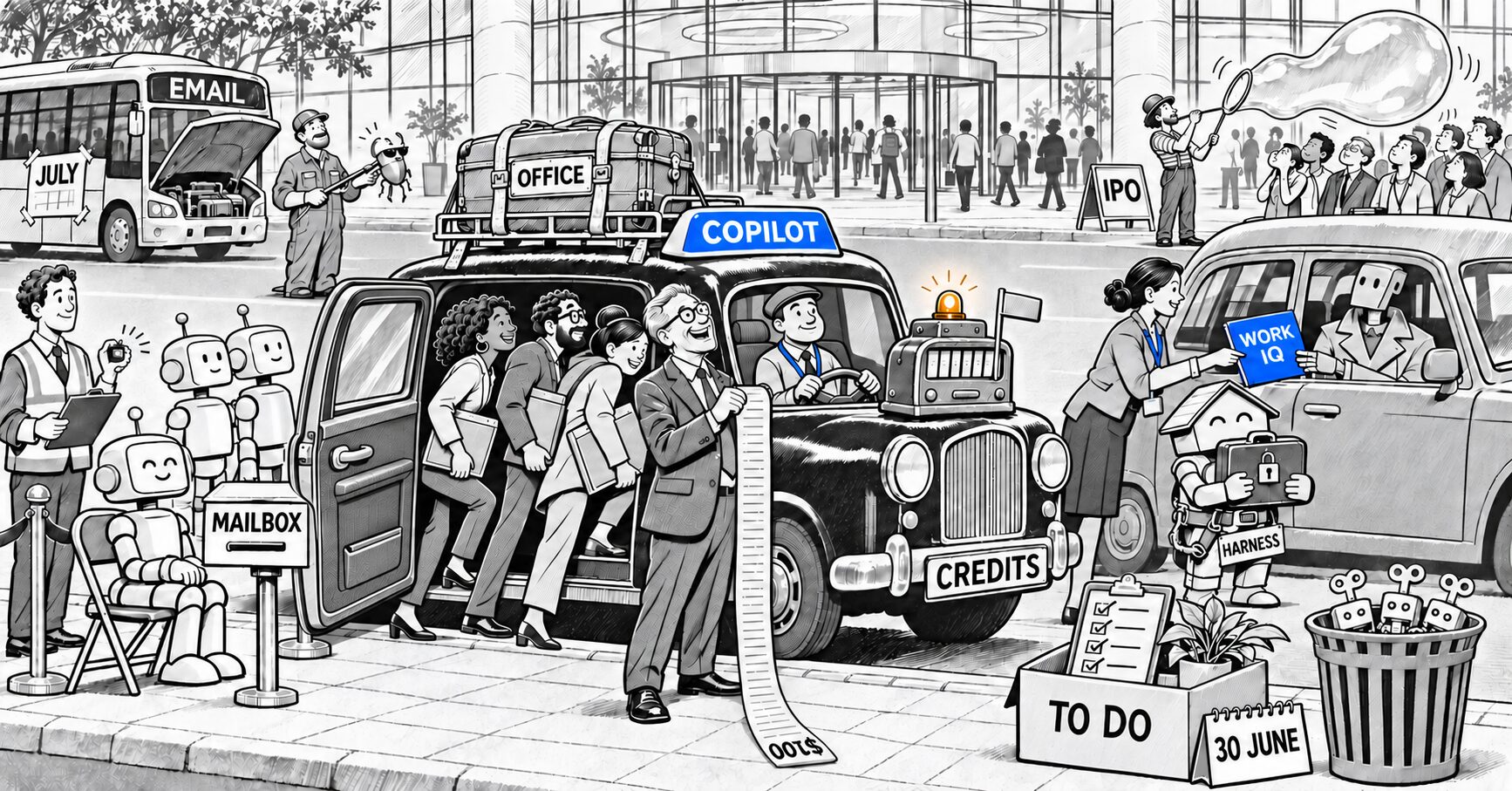
At the keynote Judson Althoff showed a two-hour Microsoft 365 Copilot session that cost $100 in credits, and pitched it as a bargain...
He'd used it on a Sunday to build a keynote outline, a slide deck and a customer tracker, plus an agent to keep the work going. That came to about 10,000 Copilot Credits (KEY01).
So what's in the licence? Chat, Office in Copilot and Auto mode, which picks the model for you (BRK216). Microsoft says more than 90% of queries use Auto (INV640). Cowork, Copilot Code, Autopilot, the premium models and Copilot Studio agents all draw on Copilot Credits, and fast mode is charged at twice the rate (BRK233).
Microsoft was open about not having this worked out. "We haven't found a customer that budgets in Copilot credits yet" (BRK532). Credits switching on by default for new Copilot Business seats has moved from 1 December to some time between January and March, with a cap of 4,000 credits per user per month when it lands (BRK502, a partner session). And because credits are now shared between the Power Platform admin center and the Microsoft 365 admin center, customers are giving the lot to Copilot Studio by accident and leaving none for Cowork (BRK262).
The controls do exist. Spending policies apply by tenant, group, user, service and model family, with alerts and hard limits (BRK205), and cost management in the Microsoft 365 admin center doesn't need an Agent 365 licence. Microsoft's advice is to set them before the usage starts (BRK266).
For Althoff it probably was a bargain. If 200 users each do that once a month, that's $20,000 a month on top of the Microsoft 365 Copilot licences you already pay for. In the same keynote Jacob Andreou called Copilot "the only way to draft a PowerPoint presentation without spinning a meter". Althoff's session included a slide deck and still used credits, and you'd struggle to tell what was included and what cost extra. You'll be able to see the bill. Working out what causes it is still on you.
Agents get a mailbox and a seat
Autopilot shows where Microsoft 365 Copilot is heading.
Cowork does a task when you ask. Autopilot is a persistent agent with its own identity, mailbox and OneDrive that works on your behalf: "always on, 24 by 7… like a digital employee that other people work with" (BRK202). You can't have it yet. Microsoft's own session says it'll be "in a limited preview for quite a while" (BRK212). It needs the Frontier programme and Copilot Credits billing, and it starts with eligible US customers (MC1557730). Autopilots working with each other are held back too: "we're seeing very interesting behaviors when we get Autopilots to talk to each other".
The same idea turned up elsewhere. Microsoft Foundry now lets you build agents with their own Entra agent user account, which gives each one an email address, a calendar, a OneDrive, Teams presence and a place in the org chart, plus a manager who answers for it. In Microsoft Teams, Agentic Users (public preview) let an agent join a team under its own identity with an accountable owner.
Agent 365 is where they all get counted. Microsoft says more than 50 million agents have been registered since May. At Ignite it added Entra Agent ID for agents from Amazon Bedrock, Google, Salesforce, Databricks, Snowflake, Anthropic and OpenAI (preview), one view of agent risk across the admin portals (preview), and discovery of local agents such as Claude Code and GitHub Copilot CLI on developers' PCs (BRK339). Agent 365 comes with Microsoft 365 E7 or as an add-on to E5.
The same week brought a supply chain attack on agent tooling. On 17 November, keynote day, two malicious versions of Microsoft's Agent Framework Python package were published to PyPI about half an hour apart. They kept the framework working while trying to steal secrets, including Azure managed identity and Azure DevOps tokens. Both are quarantined and 1.26.0 is the last clean release. If 1.26.1 or 1.26.2 reached a developer machine or a pipeline, rotate the credentials.
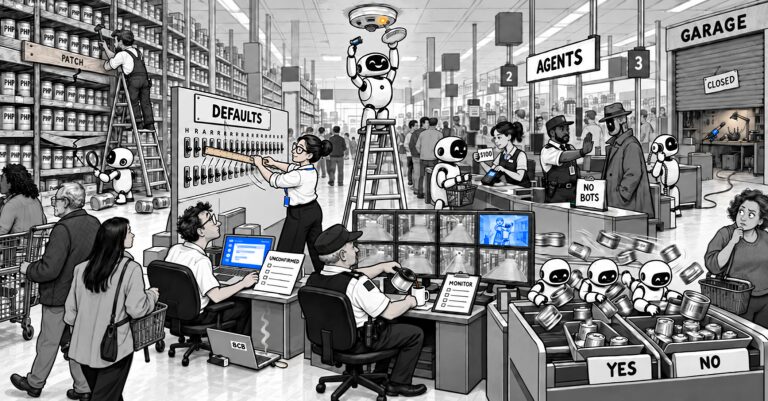
Autopilot isn't something to roll out this quarter. Agent 365 is the inventory, with owners, sponsors, activity and cost for Microsoft and third-party agents, and creating agents is getting easier: SharePoint agents need no approval (ODSP2215, a partner session), and from late November any user can create an agent blueprint unless you stop them (THR1001). Local agents such as Claude Code are already on developers' devices.
Microsoft and everyone else's AI
Microsoft seemed a lot more bullish at Ignite about what sets Microsoft 365 Copilot apart.
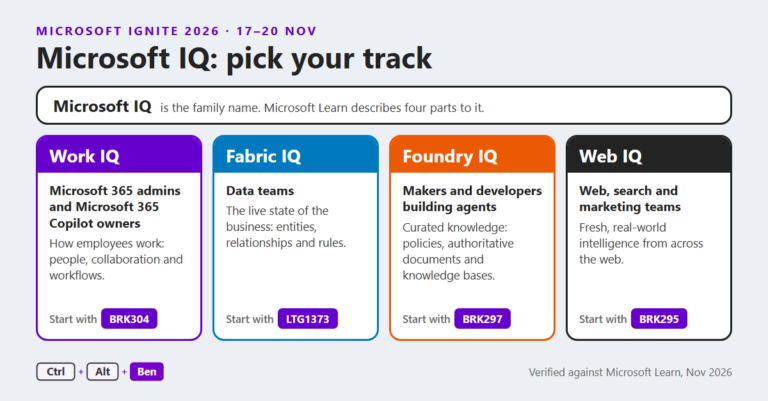
Work IQ, the layer that gives Copilot its work context, is available as a plugin in ChatGPT today, with Anthropic and Gemini to follow (BRK302). Coming the other way, Copilotforce is a new partnership with Salesforce. It includes a Salesforce plugin for Microsoft 365 Copilot in public preview, with more than 38 prebuilt sales skills that work through Salesforce's MCP access inside the permissions a seller already has.
Microsoft AI announced seven models of its own. MAI Code 2 and MAI Code 2 Flash are in GitHub Copilot already, and MAI Licensed Weights, coming through the Frontier programme, will let organisations run and customise the models in their own Azure environment.
On the show floor, some demo stations compared Microsoft 365 Copilot directly with Anthropic's Claude app. In one, Microsoft 365 Copilot read documents carrying Purview sensitivity labels, pulled the figures into a new document and put a matching label on the output. Claude wrote a similar outline but couldn't read the protected files. In another, a leaver flagged as a risk asked about a confidential project. Microsoft 365 Copilot refused, and in the demo Claude handed the information over.
The thing Microsoft is trying to highlight is the harness. With the same models underneath, Microsoft 365 Copilot can understand your data and its protections in ways that third parties using connectors currently can't. Microsoft 365 data now reaches other AI tools, so the permissions and policies on that data matter more. If you're using it in third-party AI services, check which protections and controls their connectors can use. As for the new models, Auto mode picks them for users anyway.
What didn't get a keynote slide
Microsoft bought Wunderlist back in 2015, and I was an ardent user until it stopped supporting personal-to-work list sync.
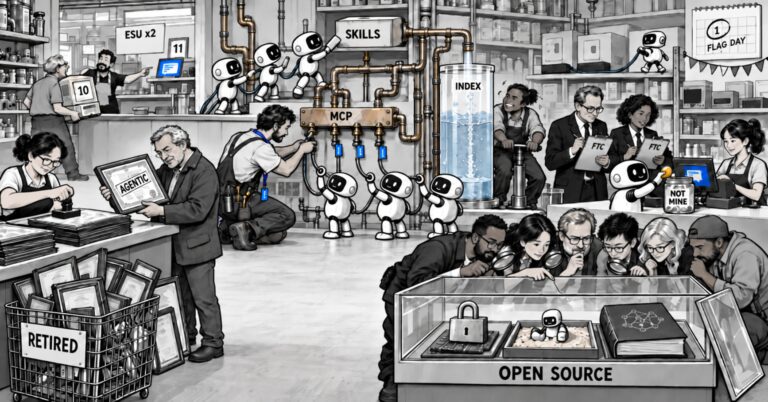
The Microsoft To Do apps retire on 30 June 2027, on the web, Windows, Mac, iOS and Android. Microsoft is pointing work and school users at Microsoft Planner, which gets an updated My Tasks experience from December. Microsoft's support page says existing tasks and lists won't migrate, and that native Planner apps for Windows and Mac "are not planned as replacements". Planner isn't available to personal accounts, so those users get an export (instructions still to come) and nothing else. The underlying To Do service, APIs and sync retire later, on dates Microsoft hasn't given. A Planner session at Ignite added that the basic, premium and To Do plan types are merging into one (THR855).
The People, Files and Calendar companion apps for Windows 11 go sooner. They stop working on 16 December, 14 months after they were added automatically to devices with commercial Microsoft 365 licences.
Also off the main stage:
- Microsoft Teams. Brand and domain impersonation warnings on inbound calls are generally available (BRK213). Impersonation warnings in meetings follow from mid-December, and a Facilitator skill that scans the transcript for signs of social engineering in late January (Office 365 for IT Pros).
- Windows. PowerShell 7 ships in the box with the next Windows 11 release in 2027, with Windows PowerShell 5.1 still available at first (BRK393). Administrator Protection is generally available and off by default (BRK392).
- Copilot on Windows. Diagnosing what's wrong with your PC from a read-only local scan was demoed and is "coming soon".
- Microsoft Teams Rooms. Nothing. Devices appeared only in partner sessions.
Losing that sync broke my workflows, so I went elsewhere. To Do has some great features (My Day, auto lists for flagged email etc.), but it's apparent Microsoft is now more interested in driving use of Planner. The companion apps are weird little Copilot side things that rolled out without fanfare and will probably disappear the same way. And for the Teams devices crowd, the lack of Microsoft Rooms news is the news.
And finally, outside Moscone
We get an explanation for the outage.
The last edition ended with Microsoft owing everyone a post-incident report. The preliminary version names three causes. One of the two network gateways wasn't working for Microsoft Teams, which pushed the load onto the other. Nearly 14% of that gateway's capacity was already out of service from an unrelated issue the day before. And the extra load tripped a bug that had been sitting in the gateway servers since July. With a bug that old there was no recent change to roll back, and servers that came back were swamped by waiting traffic and stopped responding again. The Verge's account has it starting in Switzerland and reaching more than 80% of Exchange Online servers.
An Anthropic mathematician, Levent Alpöge, says he has proved the Riemann Hypothesis with Claude over six weeks. The proof is written in Lean and runs to more than 250,000 pages, so checking it will take a while. One Oxford mathematician told The New York Times he was "98 or 99 percent certain" it holds.
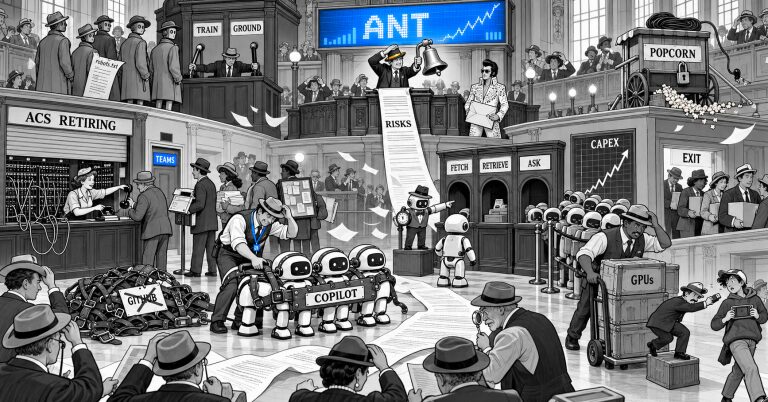
And on Thursday Anthropic started trading on the Nasdaq as "ANT". Priced at $83 a share, which valued it at around $1.5 trillion, it opened at $111.50 and settled to about $100 within the hour. Its filing shows $16.3 billion of revenue in the first half of this year against an $80.7 billion net loss, most of which is an accounting charge.
The world watches to see what kind of a bubble we're in as Anthropic takes the public plunge.
The thread
Copilot is coming together, and the parts that do the most work run on a meter. Agents are getting identities, mailboxes and managers, and Agent 365 is where you count them. Microsoft's pitch against everyone else's AI is the harness around your data. And the things that went away last week (To Do, the companion apps) did it without a keynote slide.
If a weekly roll-up in your feed is useful, the 365 Explained podcast goes deeper on the M365 side: YouTube playlist or RedCircle, or search "365 Explained" wherever you listen.
Ta, Ben.